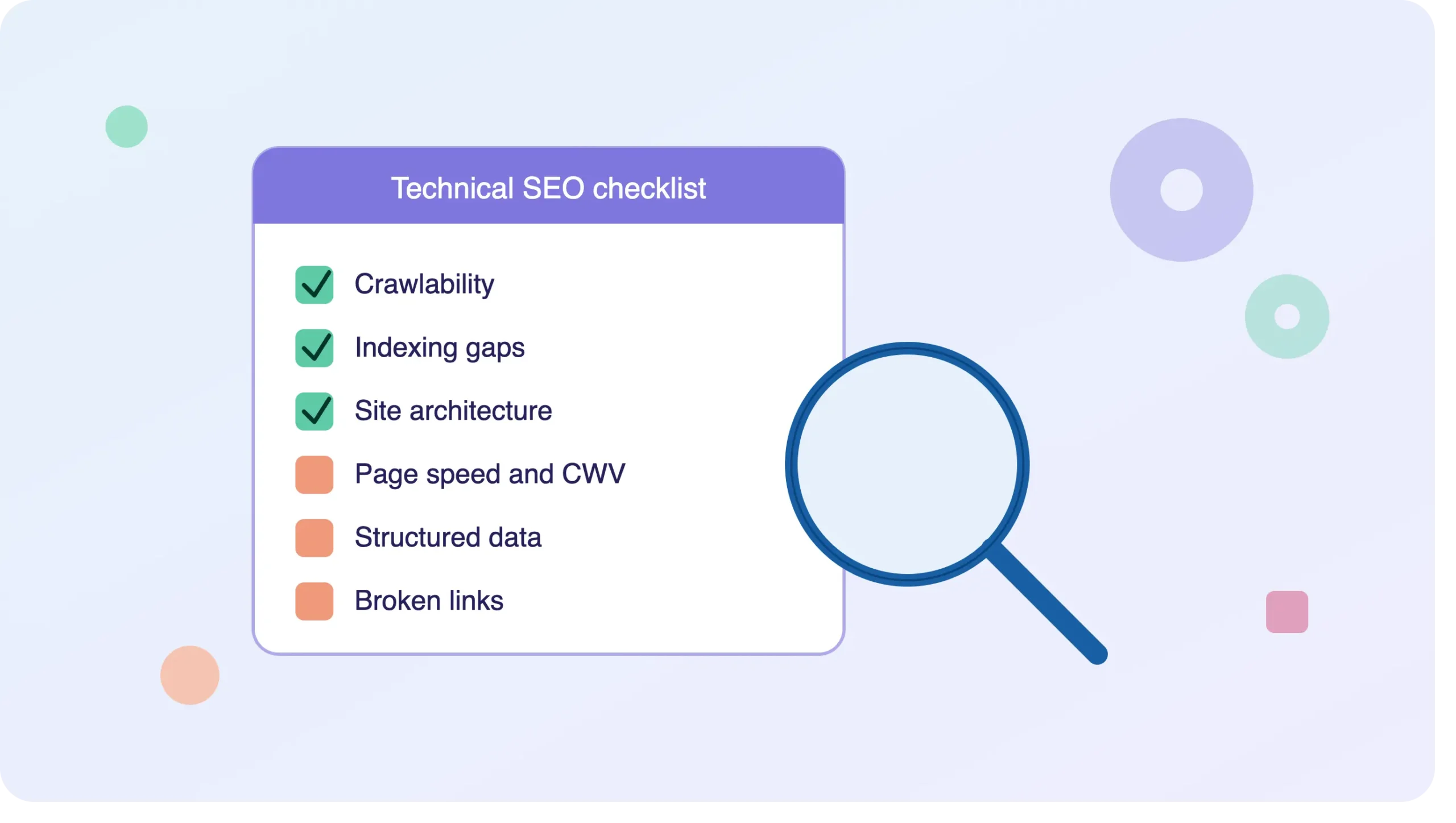

A practical technical SEO checklist covering crawling, indexing, site speed, and structure, the issues most likely to be holding your rankings back right now.
Great content can’t rank if search engines can’t crawl, index, or understand it. Technical SEO is the foundation everything else sits on and it’s usually invisible until something breaks. Here’s a practical checklist covering the issues we see most often when auditing sites.
1. Crawlability
Start by confirming search engines can actually reach your pages.
- Check your
robots.txtfile isn’t accidentally blocking important sections - Make sure important pages aren’t set to
noindexby mistake (a common leftover from staging environments) - Submit an updated XML sitemap through Google Search Console
2. Indexing gaps
Not every crawled page gets indexed. In Search Console’s Page Indexing report, look for:
- “Crawled – currently not indexed” (often a content-quality or duplication signal)
- “Discovered – currently not indexed” (often a crawl-budget or internal-linking issue)
- Pages incorrectly canonicalized to a different URL
3. Site architecture
A flat, logical structure helps both users and crawlers. Aim for important pages to be reachable within 3 clicks from the homepage, and group related content into clear categories or topic clusters rather than a flat list of disconnected pages.
4. Internal linking
Internal links pass authority and context between pages. Common issues:
- Orphan pages with zero internal links pointing to them
- Over-reliance on navigation links, with no contextual links from content
- Generic anchor text (“click here”) instead of descriptive, keyword-relevant text
5. Page speed and Core Web Vitals
Speed is both a ranking factor and a conversion factor. Focus on:
- Largest Contentful Paint (LCP) – ideally under 2.5 seconds
- Cumulative Layout Shift (CLS) – avoid content jumping as the page loads
- Compressing and lazy-loading images, especially above-the-fold hero images
6. Mobile usability
With mobile-first indexing, Google evaluates your mobile version primarily. Check that text is readable without zooming, tap targets aren’t cramped, and nothing is cut off or overlapping on smaller screens.
7. Duplicate content and canonicalization
Duplicate or near-duplicate pages (common with filtered product listings, print versions, or URL parameters) confuse search engines about which version to rank. Use canonical tags consistently, and consolidate near-duplicate pages where possible.
8. HTTPS and security
Confirm your entire site runs on HTTPS with no mixed-content warnings, and that old HTTP URLs redirect properly rather than returning errors.
9. Structured data (schema markup)
Schema helps search engines understand your content and can unlock rich results. At minimum, most sites benefit from Organization schema, and content-heavy sites benefit from Article/BlogPosting schema on posts and Breadcrumb schema for navigation.
10. Broken links and redirect chains
Run a crawl to find 404s and multi-step redirect chains (A → B → C). Both waste crawl budget and dilute link equity, fix them to point directly to the final destination.
11. URL structure
Keep URLs short, descriptive, and consistent (lowercase, hyphens between words, no unnecessary parameters). Avoid changing URL structures without proper 301 redirects in place.
12. Log file analysis (for larger sites)
For sites with thousands of pages, reviewing server logs shows you exactly how search engine bots are crawling your site, which pages they visit often, which they ignore, and where crawl budget is being wasted.
Where to start: If you only have time for three things this month: fix any accidental noindex tags, resolve your worst Core Web Vitals issues, and clean up your internal linking to your most important pages. Those three tend to move the needle fastest.
A technical SEO audit will surface the issues specific to your site, including the ones that don’t show up until someone looks under the hood. Explore our Technical SEO services.
